Michael’s thwarted beacon attempt
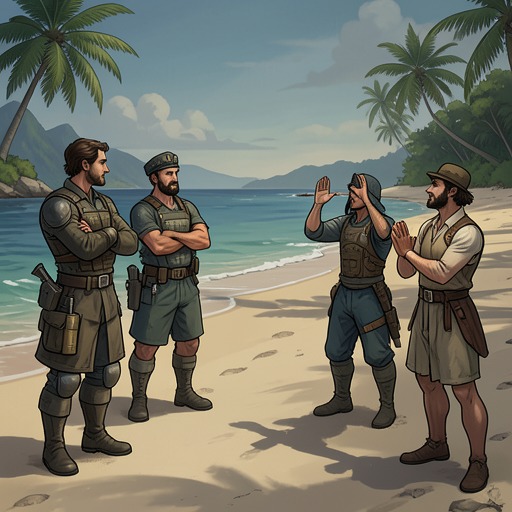
Kensuke's KingdomMichael’s thwarted beacon attempt is a turning point in his struggle to get off Kensuke’s island: a distant ship makes rescue seem possible, but Kensuke destroys Michael’s prepared signal before it can be seen. Michael’s hope collapses into anger, and he challenges the rules that have kept him within a boundary on the island. The scene presents their conflict as more than a dispute about fire: Michael experiences the prohibition as captivity, while Kensuke’s later account reveals that he feared the signal would bring hunters to the island.
The First Ship and the Failed Chance
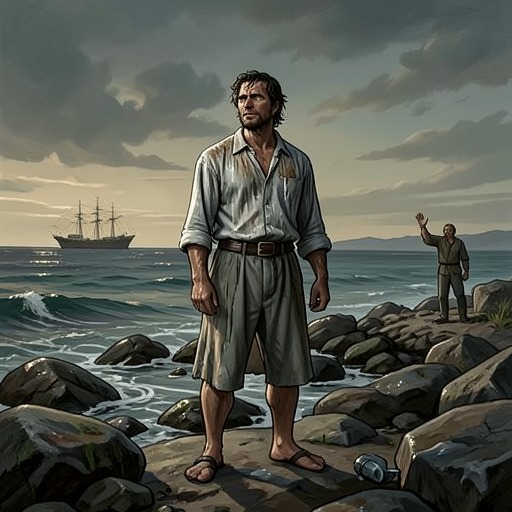
Michael has already named the hill where he watches for vessels “Watch Hill,” distinguishing it from the hill he calls “His Hill.” One morning, while repairing his palm-leaf hat, he spots a large tanker on the horizon. He immediately shouts and waves, but the ship does not turn. Its distance and the island’s small, hazy appearance make it unlikely that anyone aboard could see him. As it passes out of sight over the course of the morning, Michael is left with the sense that a rare opportunity has slipped away.
The missed sighting sharpens a conflict already present in his life on the island. Kensuke has supplied Michael with food and shelter, but has also forbidden fire and confined him to one end of the island. Michael recognizes both sides of this arrangement: Kensuke is keeping him alive, yet the prohibition also prevents him from signaling ships. Watching the tanker depart, Michael thinks that even a small chance of being spotted would have existed if he had been allowed to make smoke.
A Secret Beacon
Rather than abandon the attempt, Michael decides to prepare for the next passing vessel. He still has his fireglass, and plans a large beacon on the seaward side of Watch Hill, positioned where ships might see it but hidden from Kensuke’s view behind rocks. He intends to assemble the wood without lighting it until a ship appears, keeping tinder-dry leaves ready so he can raise a strong smoke signal quickly.
The plan requires sustained work. Michael spends the hours he once used simply watching the horizon hauling branches up the rocky slope and piling them at the summit. He takes care to stay out of Kensuke’s sight, believing that Kensuke may be watching him, and imagines that only someone looking from the sea could see what he is building. After several days, the beacon is nearly complete. An orangutan comes upon him while he is adding a large branch, watches him briefly, and then moves back toward the trees. Michael wonders whether the animal might somehow alert Kensuke, though he recognizes that this is only his own suspicion.
A storm then holds the island for four days. Michael and Stella shelter in the cave while the wind and rain continue. Even during the storm, Kensuke leaves fish and fruit for them beneath the tin wedged under the rock shelf. When the weather clears, Michael climbs Watch Hill and finds that the beacon has survived, though it is sodden. He must wait for it to dry before trying to use it, then gathers another cache of dry leaves and twigs in a deep cleft in the rock. The repeated preparation makes the signal a deliberate, long-term plan rather than an impulsive response to a single sighting.
The Attempt and Its Destruction
The next opportunity arrives unexpectedly. Michael has just come out of the cave when he sees a boat with red-brown sails, which he takes for a Chinese junk, not far offshore. He runs down the beach shouting, but quickly understands that he is still too far away to be seen or heard. He turns to the beacon, races up Watch Hill with Stella following, and lays out the dry leaves and fireglass.
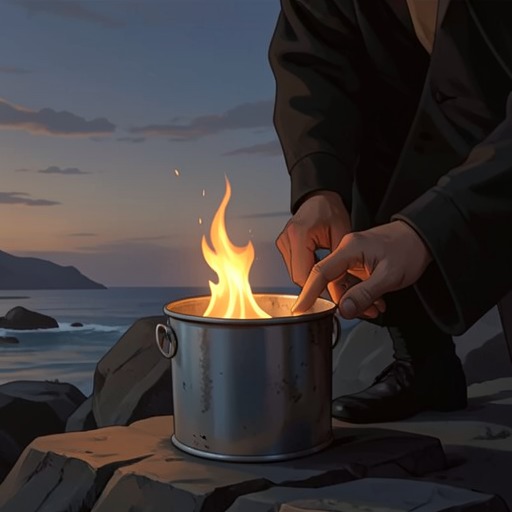
His excitement and exhaustion make his hands shake too much to hold the glass steady. He props it on a frame of twigs, as he has done before, and watches the junk continue slowly away. At last smoke appears, followed by a small flame spreading along a leaf. As Michael bends to blow it into life, he sees Kensuke standing over him.
Kensuke does not argue. He stamps out the beginning of the fire, takes the fireglass and throws it against a rock, where it breaks, then kicks apart the dry leaves and dismantles the beacon branch by branch. The orangutans gather to watch. Michael expects Kensuke to shout, but instead he speaks quietly and deliberately, saying, “Dameda.” The brief word marks the force of the prohibition even as Kensuke’s restrained manner contrasts with Michael’s panic and grief.
Michael protests that he wants to go home and asks why Kensuke will not let him. Kensuke seems, for a moment, to show some understanding; he bows stiffly and apologizes, saying, “Gomenasai. Gomenasai. Sorry. Very sorry.” Then he leaves, followed by the orangutans. His apology does not restore the beacon or change the outcome: the boat recedes, and Michael watches it until it is only a spot on the horizon.
From Despair to Defiance
The destruction of the beacon changes Michael’s response to his confinement. He had regarded the boundary as a rule he might endure while hoping for rescue; now, angry that Kensuke has prevented even an attempt to signal a ship, he deliberately steps across it. He calls out to Kensuke to make sure his disobedience is seen, then goes into the sea despite the prohibition against swimming.
This act of defiance leads directly to a new crisis. A jellyfish stings Michael repeatedly, and he becomes unable to swim back to shore. Kensuke sees what is happening and shouts and waves his stick, but Michael sinks beneath the water. He later wakes in a cave, unable to move and in severe pain; Kensuke has rescued him and treated him with vinegar. The failed beacon therefore does not simply close off an escape route: it helps precipitate the event that forces Michael to depend on the person he has just challenged.
The Meaning of Kensuke’s Prohibition
Kensuke’s reasons are not fully known to Michael during the beacon episode. Later, Kensuke explains that hunters had come to the island with guns, killing gibbon mothers and taking their young. He had hidden the orangutans in his cave when he sang to them, and came to think of people as killers. He also feared that people might find him and take him away. From this history, the ban on fire and the destruction of a visible signal can be understood as attempts to keep outsiders from discovering the island and its animals.
That explanation does not erase the conflict. Michael’s desire to return home is real, and Kensuke’s care for him coexists with a decision that prevents him from pursuing rescue. The beacon scene gives that contradiction a physical form: Kensuke has kept Michael supplied and alive, yet destroys the very object Michael has built to leave. Its immediate result is separation and anger; its longer consequence is that Michael’s open defiance, the jellyfish emergency, and Kensuke’s rescue bring the two into a deeper dependence, before they can explain their opposing fears to one another.